Kingim Under The Sea And Other Stories Free Download UPDATED
Kingim Under The Sea And Other Stories Free Download
| Sea anemone Temporal range: Upper Cambrian to Present | |
|---|---|
 | |
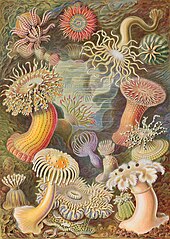
| A option of sea anemones, painted by Giacomo Merculiano, 1893 | |
Scientific classification  | |
| Kingdom: | Animalia |
| Phylum: | Cnidaria |
| Class: | Hexacorallia |
| Club: | Actiniaria |
| Suborders | |
| |
| Diversity | |
| 46 families | |
Sea anemones are a group of predatory marine animals of the order Actiniaria. They are named subsequently the anemone, a terrestrial angiosperm, because of the colourful advent of many. Sea anemones are classified in the phylum Cnidaria, class Anthozoa, bracket Hexacorallia. As cnidarians, body of water anemones are related to corals, jellyfish, tube-dwelling anemones, and Hydra. Different jellyfish, sea anemones do not have a medusa stage in their life cycle.
A typical body of water anemone is a single polyp attached to a hard surface past its base of operations, but some species live in soft sediment, and a few bladder nigh the surface of the water. The polyp has a columnar trunk topped past an oral disc with a ring of tentacles and a key oral fissure. The tentacles can be retracted within the torso cavity or expanded to catch passing prey. They are armed with cnidocytes (stinging cells). In many species, boosted nourishment comes from a symbiotic relationship with single-celled dinoflagellates, with zooxanthellae, or with green algae, zoochlorellae, that live within the cells. Some species of sea anemone live in clan with hermit crabs, modest fish, or other animals to their mutual do good.
Bounding main anemones breed past liberating sperm and eggs through the oral fissure into the body of water. The resulting fertilized eggs develop into planula larvae which, after being planktonic for a while, settle on the seabed and develop directly into juvenile polyps. Body of water anemones as well brood asexually, by breaking in half or into smaller pieces which regenerate into polyps. Body of water anemones are sometimes kept in reef aquariums; the global merchandise in marine ornamentals for this purpose is expanding and threatens sea anemone populations in some localities, as the merchandise depends on collection from the wild.
Beefcake [edit]
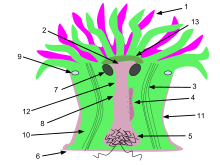
Bounding main anemone beefcake.
1. Tentacles 2. Mouth 3. Retracting muscles 4. Gonads 5. Acontial filaments 6. Pedal disk vii. Ostium viii. Coelenteron 9. Sphincter muscle 10. Mesentery 11. Column 12. Throat
A typical body of water anemone is a sessile polyp attached at the base of operations to the surface below it by an adhesive foot, called a basal or pedal disc, with a cavalcade-shaped trunk topped past an oral disc. About are from 1 to 5 cm (0.4 to ii.0 in) in diameter and i.5 to 10 cm (0.6 to 3.nine in) in length, but they are inflatable and vary greatly in dimensions. Some are very big; Urticina columbiana and Stichodactyla mertensii tin both exceed a metre in diameter and Metridium farcimen a metre in length.[1] Some species burrow in soft sediment and lack a basal disc, having instead a bulbous lower end, the physa, which anchors them in place.[1]
The column or trunk is more often than not more or less cylindrical and may exist plain and smooth or may bear specialised structures; these include solid papillae (fleshy protuberances), agglutinative papillae, cinclides (slits), and pocket-size protruding vesicles. In some species the part immediately below the oral disc is constricted and is known as the capitulum. When the fauna contracts, the oral disc, tentacles and capitulum fold inside the throat and are held in identify past a potent sphincter muscle part way up the cavalcade. In that location may be a fold in the trunk wall, known as a parapet, at this point, and this parapet covers and protects the anemone when information technology is retracted.[one]
The oral disc has a fundamental mouth, usually slit-shaped, surrounded by i or more whorls of tentacles. The ends of the slit lead to grooves in the wall of the pharynx known as siphonoglyphs; in that location are commonly 2 of these grooves, but some groups have a unmarried one. The tentacles are more often than not tapered and often tipped past a pore, but in some species they are branched, gild-tipped, or reduced to low knobs.[1] The tentacles are armed with many cnidocytes, cells that are both defensive and used to capture prey. Cnidocytes contain stinging nematocysts, capsule-like organelles capable of everting all of a sudden, giving the phylum Cnidaria its name.[two] Each nematocyst contains a pocket-sized venom vesicle filled with actinotoxins, an inner filament, and an external sensory pilus. A touch to the pilus mechanically triggers a jail cell explosion, which launches a harpoon-like structure that attaches to the organism that triggered it, and injects a dose of venom in the mankind of the assaulter or prey.[3] At the base of the tentacles in some species prevarication acrorhagi, elongated inflatable tentacle-like organs armed with cnidocytes, that tin can flail effectually and fend off other encroaching anemones; one or both anemones can be driven off or suffer injury in such battles.[ane]

The venom is a mix of toxins, including neurotoxins, that paralyzes the casualty so the anemone tin move it to the mouth for digestion within the gastrovascular cavity. Actinotoxins are highly toxic to prey species of fish and crustaceans. However, Amphiprioninae (clownfish), small banded fish in various colours, are not affected by their host anemone'south sting and shelter themselves from predators amid its tentacles.[iv] Several other species accept similar adaptions and are also unaffected (encounter Mutualistic relationships). Most sea anemones are harmless to humans, but a few highly toxic species (notably Actinodendron arboreum, Phyllodiscus semoni and Stichodactyla spp.) have acquired severe injuries and are potentially lethal.[5]
Digestive system [edit]
Bounding main anemones have what can be described as an incomplete gut; the gastrovascular crenel functions as a breadbasket and possesses a single opening to the outside, which operates as both a oral fissure and anus. Waste and undigested matter is excreted through this opening. The mouth is typically slit-like in shape, and bears a groove at one or both ends. The groove, termed a siphonoglyph, is ciliated, and helps to move nutrient particles in and circulate water through the gastrovascular crenel.[half dozen]
The mouth opens into a flattened throat. This consists of an in-folding of the body wall, and is therefore lined past the brute's epidermis. The pharynx typically runs for most one tertiary the length of the trunk before opening into the gastrovascular cavity that occupies the remainder of the body.[1]
The gastrovascular cavity itself is divided into a number of chambers by mesenteries radiating inwards from the body wall. Some of the mesenteries form complete partitions with a free border at the base of operations of the pharynx, where they connect, but others accomplish merely partway beyond. The mesenteries are commonly establish in multiples of twelve, and are symmetrically arranged around the central lumen. They have stomach lining on both sides, separated by a thin layer of mesoglea, and include filaments of tissue specialised for secreting digestive enzymes. In some species, these filaments extend below the lower margin of the mesentery, hanging free in the gastrovascular cavity as thread-similar acontial filaments. These acontia are armed with nematocysts and can be extruded through cinclides, cicatrice-like holes in the wall of the column, for use in defence.[6]
Musculature and nervous system [edit]

A primitive nervous organization, without centralization, coordinates the processes involved in maintaining homeostasis, every bit well equally biochemical and physical responses to diverse stimuli. There are two nervus nets, 1 in the epidermis and 1 in the gastrodermis; these unite at the pharynx, the junctions of the septa with the oral disc and the pedal disc, and beyond the mesogloea. No specialized sense organs are present, but sensory cells include nematocytes and chemoreceptors.[1]
The muscles and fretfulness are much simpler than those of most other animals, although more specialised than in other cnidarians, such as corals. Cells in the outer layer (epidermis) and the inner layer (gastrodermis) have microfilaments that grouping into contractile fibers. These fibers are not true muscles because they are not freely suspended in the trunk crenel as they are in more developed animals. Longitudinal fibres are found in the tentacles and oral disc, and also within the mesenteries, where they can contract the whole length of the body. Circular fibers are constitute in the body wall and, in some species, around the oral disc, allowing the animal to retract its tentacles into a protective sphincter.[six]
Since the anemone lacks a rigid skeleton, the contractile cells pull confronting the fluid in the gastrovascular cavity, forming a hydrostatic skeleton. The anemone stabilizes itself by flattening its pharynx, which acts as a valve, keeping the gastrovascular cavity at a abiding volume and making it rigid. When the longitudinal muscles relax, the pharynx opens and the cilia lining the siphonoglyphs crush, wafting h2o in and refilling the gastrovascular crenel. In general, the sea anemone inflates its body to extend its tentacles and feed, and deflates information technology when resting or disturbed. The inflated trunk is also used to ballast the animate being inside a crevice, couch or tube.[1]
Life cycle [edit]

Unlike other cnidarians, anemones (and other anthozoans) entirely lack the free-pond medusal stage of their life cycle;[7] the polyp produces eggs and sperm, and the fertilized egg develops into a planula larva, which develops directly into another polyp. Both sexual and asexual reproduction can occur.[1]
The sexes in sea anemones are separate in some species, while other species are sequential hermaphrodites, irresolute sexual practice at some stage in their life. The gonads are strips of tissue within the mesenteries.[1] In sexual reproduction, males may release sperm to stimulate females to release eggs, and fertilization occurs, either internally in the gastrovascular crenel or in the water column. The eggs and sperm, or the larvae, ordinarily emerge through the oral fissure,[eight] but in some species, such equally Metridium dianthus, may be swept out from the body crenel through the cinclides.[ix] In many species the eggs and sperm ascent to the surface where fertilisation occurs. The fertilized egg develops into a planula larva, which drifts for a while before sinking to the seabed and undergoing metamorphosis into a juvenile bounding main anemone. Some larvae preferentially settle onto sure suitable substrates; the mottled anemone (Urticina crassicornis) for case, settles onto dark-green algae, mayhap attracted by a biofilm on the surface.[8]
The heart-searching anemone (Epiactis prolifera) is gynodioecious, starting life as a female and later becoming hermaphroditic, so that populations consist of females and hermaphrodites.[10] As a female, the eggs can develop parthenogenetically into female offspring without fertilisation, and as a hermaphrodite, the eggs are routinely self-fertilised.[8] The larvae emerge from the anemone'south mouth and tumble downward the column, lodging in a fold near the pedal disc. Here they develop and grow, remaining for about three months before crawling off to beginning independent lives.[8]
Sea anemones accept great powers of regeneration and can reproduce asexually, by budding, fragmentation, or longitudinal or transverse binary fission. Some species such as sure Anthopleura separate longitudinally, pulling themselves apart, resulting in groups of individuals with identical colouring and markings.[11] Transverse fission is less common, but occurs in Anthopleura stellula and Gonactinia prolifera, with a rudimentary band of tentacles appearing halfway up the column earlier information technology splits horizontally.[12] Some species tin can likewise reproduce past pedal laceration. In this procedure, a ring of material may intermission off from the pedal disc at the base of the column, which then fragments, the pieces regenerating into new clonal individuals.[13] Alternatively, fragments detach separately as the animal creeps across a surface. In Metridium dianthus, fragmentation rates were higher in individuals living amongst alive mussels than among dead shells, and all the new individuals had tentacles within three weeks.[14]
The sea anemone Aiptasia diaphana displays sexual plasticity. Thus asexually produced clones derived from a single founder individual can contain both male and female person individuals (ramets). When eggs and sperm (gametes) are formed, they tin produce zygotes derived from "selfing" (within the founding clone) or out-crossing, which then develop into swimming planula larvae.[15] Anemones tend to grow and reproduce relatively slowly. The magnificent sea anemone (Heteractis magnifica), for example, may live for decades, with one individual surviving in captivity for eighty years.[16]
Behaviour and ecology [edit]
Motility [edit]
A sea anemone is capable of changing its shape dramatically. The column and tentacles take longitudinal, transverse and diagonal sheets of muscle and can lengthen and contract, likewise equally bend and twist. The gullet and mesenteries can evert (turn within out), or the oral disc and tentacles can retract inside the gullet, with the sphincter endmost the aperture; during this process, the gullet folds transversely and water is discharged through the oral fissure.[17]
Locomotion [edit]
Although some species of ocean anemone burrow in soft sediment, the bulk are mainly sessile, attaching to a hard surface with their pedal disc, and tend to stay in the same spot for weeks or months at a fourth dimension. They tin can move, nevertheless, existence able to pitter-patter around on their bases; this gliding can be seen with fourth dimension-lapse photography but the motility is so ho-hum as to exist about imperceptible to the naked eye.[18] The process resembles the locomotion of a gastropod mollusc, a moving ridge of contraction moving from the functionally posterior portion of the foot towards the front edge, which detaches and moves frontward.[19] Sea anemones can also cast themselves loose from the substrate and drift to a new location.[18] Gonactinia prolifera is unusual in that it can both walk and swim; walking is by making a series of short, looping steps, rather like a caterpillar, attaching its tentacles to the substrate and cartoon its base closer; swimming is washed past rapid movements of the tentacles beating synchronously like oar strokes.[20] Stomphia coccinea tin swim by flexing its cavalcade, and the sea onion anemone inflates and casts itself loose, adopting a spherical shape and allowing itself to be rolled about by the waves and currents.[1] There are no truly pelagic sea anemones, but some stages in the life wheel post-metamorphosis are able, in response to certain environmental factors, to cast themselves off and have a complimentary-living phase that aids in their dispersal.[21]
The sea onion Paranthus rapiformis lives on subtidal mud flats and burrows into the sediment, holding itself in place past expanding its basal disc to form an anchor. If it gets done out of its burrow by strong currents, information technology contracts into a pearly glistening ball which rolls about.[22] Tube-home anemones, which alive in parchment-like tubes, are in the anthozoan subclass Ceriantharia, and are merely distantly related to sea anemones.[23]
Feeding and diet [edit]

Tentacles of Aulactinia veratra grab passing prey and thrust it into the oral fissure in the eye of the oral disc.
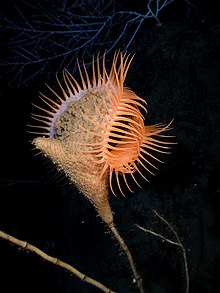
Sea anemones are typically predators, ensnaring prey of suitable size that comes within reach of their tentacles and immobilizing it with the aid of their nematocysts.[24] The prey is and then transported to the oral cavity and thrust into the pharynx. The lips tin stretch to assist in casualty capture and tin accommodate larger items such as crabs, dislodged molluscs and fifty-fifty small fish.[1] Stichodactyla helianthus is reported to trap sea urchins by enfolding them in its carpet-like oral disc.[one] A few species are parasitic on other marine organisms.[24] One of these is Peachia quinquecapitata, the larvae of which develop within the medusae of jellyfish, feeding on their gonads and other tissues, earlier existence liberated into the sea as free-living juvenile anemones.[25]
Mutualistic relationships [edit]
Although not plants and therefore incapable of photosynthesis themselves, many bounding main anemones class an important facultative mutualistic relationship with certain single-celled algae species that reside in the animals' gastrodermal cells, specially in the tentacles and oral disc. These algae may be either zooxanthellae, zoochlorellae or both. The sea anemone benefits from the products of the algae'southward photosynthesis, namely oxygen and food in the form of glycerol, glucose and alanine; the algae in turn are assured a reliable exposure to sunlight and protection from micro-feeders, which the sea anemones actively maintain. The algae also benefit by being protected by the sea anemone's stinging cells, reducing the likelihood of being eaten past herbivores. In the accumulation anemone (Anthopleura elegantissima), the color of the anemone is largely dependent on the proportions and identities of the zooxanthellae and zoochlorellae present.[i] The hidden anemone (Lebrunia coralligens) has a whorl of seaweed-like pseudotentacles, rich in zooxanthellae, and an inner ringlet of tentacles. A daily rhythm sees the pseudotentacles spread widely in the daytime for photosynthesis, simply they are retracted at night, at which time the tentacles aggrandize to search for prey.[26]

Several species of fish and invertebrates live in symbiotic or mutualistic relationships with sea anemones, almost famously the clownfish. The symbiont receives the protection from predators provided by the anemone's stinging cells, and the anemone utilises the nutrients present in its faeces.[27] Other animals that associate with bounding main anemones include cardinalfish (such as Banggai cardinalfish), juvenile threespot dascyllus,[28] incognito (or anemone) goby,[29] juvenile painted greenling,[30] diverse crabs (such as Inachus phalangium, Mithraculus cinctimanus and Neopetrolisthes), shrimp (such as certain Alpheus, Lebbeus, Periclimenes and Thor),[31] opossum shrimp (such as Heteromysis and Leptomysis),[32] and various marine snails.[33] [34] [35]
Two of the more unusual relationships are those betwixt certain anemones (such as Adamsia, Calliactis and Neoaiptasia) and hermit crabs or snails, and Bundeopsis or Triactis anemones and Lybia boxing crabs. In the quondam, the anemones live on the beat of the hermit crab or snail.[31] [33] [34] [35] In the latter, the small anemones are carried in the claws of the boxing crab.[31] [36]
Habitats [edit]
Bounding main anemones are plant in both deep oceans and shallow littoral waters worldwide. The greatest diversity is in the tropics, although there are many species adapted to relatively cold waters. The majority of species cling on to rocks, shells or submerged timber, frequently hiding in cracks or under seaweed, just some burrow into sand and mud, and a few are pelagic.[ane]
Relationship with humans [edit]
Sea anemones and their attendant anemone fish tin make attractive aquarium exhibits, and both are often harvested from the wild as adults or juveniles.[37] These line-fishing activities significantly impact the populations of anemones and anemone fish by drastically reducing the densities of each in exploited areas.[37] Likewise their collection from the wild for employ in reef aquaria, sea anemones are also threatened past alterations to their surroundings. Those living in shallow-h2o coastal locations are afflicted direct by pollution and siltation, and indirectly by the effect these accept on their photosynthetic symbionts and the prey on which they feed.[38]
In southwestern Spain and Sardinia, the snakelocks anemone (Anemonia viridis) is consumed as a delicacy. The whole animal is marinated in vinegar, then coated in a batter similar to that used to make calamari, and deep-fried in olive oil.[39] Anemones are as well a source of food for fisherman communities in the east declension of Sabah, Borneo[twoscore], as well as the Thou Islands (as rambu-rambu)[41] in Southeast Asia.
Fossil record [edit]

Most Actiniaria do not form hard parts that tin can be recognized as fossils, but a few fossils of body of water anemones do exist; Mackenzia, from the Centre Cambrian Burgess Shale of Canada, is the oldest fossil identified equally a sea anemone.[42]
Taxonomy [edit]
Sea anemones, order Actiniaria, are classified in the phylum Cnidaria, class Anthozoa, subclass Hexacorallia.[43] Rodriguez et al. proposed a new classification for the Actiniaria based on extensive Deoxyribonucleic acid results.[44]
Suborders and superfamilies included in Actiniaria are:
- Suborder Anenthemonae
- Superfamily Edwardsioidea
- Superfamily Actinernoidea
- Suborder Enthemonae
- Superfamily Actinostoloidea
- Superfamily Actinioidea
- Superfamily Metridioidea
Phylogeny [edit]
External relationships [edit]
Anthozoa contains iii subclasses: Hexacorallia, which contains the Actiniaria; Octocorallia; and Ceriantharia. These are monophyletic, simply the relationships inside the subclasses remain unresolved.[45]
Internal relationships [edit]
The relationships of higher-level taxa in Carlgren's[46] nomenclature are re-interpreted as follows:[44]
| Carlgren taxon | Phylogenetic consequence |
|---|---|
| Protantheae | Sister to Boloceroidaria |
| Ptychodacteae | Polyphyletic because its members are not recovered as sis taxa; clustered with members of erstwhile Endomyaria |
| Endocoelantheae | Sister to athenarian family Edwardsiidae; together these clades are re-classified every bit suborder Anenthemonae |
| Nynantheae | Polyphyletic because of the relationship between Edwardsiidae and Endocoelantheae and because members of Protantheae and Ptychodacteae are recovered every bit sister to its members |
| Boloceroidaria | Boloceroides mcmurrichi and Bunodeopsis nested among acontiate taxa; B. daphneae apart from other Actiniaria |
| Athenaria | Polyphyletic: families formerly in this suborder distributed across tree as sister to former members of Endomyaria, Acontiaria, and Endocoelantheae |
| Thenaria | Boloceroidaria, Protantheae, Ptychodacteae, and most Athenaria nest inside this grouping |
| Endomyaria | Paraphyletic: includes Pychodacteae and some Athenaria |
| Mesomyaria | Polyphyletic: one clade at base of operations of Nynantheae, other lineages are associated with former members of Acontiaria |
| Acontiaria | Paraphyletic; includes several lineages formerly in Mesomyaria and Athenaria, plus Boloceroidaria and Protantheae |
Meet also [edit]
- AETX
- Cangitoxin
- Halcurin
- Sea anemone dermatitis
- Sea anemone neurotoxin
References [edit]
- ^ a b c d eastward f thou h i j k fifty thou north o Ruppert, Edward East.; Fob, Richard, Due south.; Barnes, Robert D. (2004). Invertebrate Zoology (7th ed.). Cengage Learning. pp. 130–132. ISBN978-81-315-0104-7.
- ^ Campbell, N.; Reece, J. (2002). Biological science (sixth ed.). San Francisco: Pearson Education. ISBN978-0-8053-0009-3.
- ^ Beckmann, A.; Özbek, Due south. (2012). "The nematocyst: a molecular map of the cnidarian stinging organelle". International Periodical of Developmental Biology. 56 (vi–8): 577–582. doi:10.1387/ijdb.113472ab. PMID 22689365.
- ^ "Fagatele Bay NMS: Clownfish and Body of water Anemone". National Marine Sanctuaries. January 12, 2006. Retrieved 2010-11-20 .
- ^ Mizuno, Masashi; Ito, Yasuhiko; Morgan, B. Paul (23 July 2012). "Exploiting the Nephrotoxic Furnishings of Venom from the Body of water Anemone, Phyllodiscus semoni, to Create a Hemolytic Uremic Syndrome Model in the Rat". Marine Drugs. ten (7): 1582–1604. doi:10.3390/md10071582. PMC3407933. PMID 22851928.
- ^ a b c Barnes, Robert D. (1982). Invertebrate Zoology. Philadelphia, PA: Holt-Saunders International. pp. 150–157. ISBN978-0-03-056747-6.
- ^ Castro, Peter; Huber, Michael E. (2010). Marine Biology. New York: McGraw-Hill. p. 121.
- ^ a b c d Carefoot, Tom. "Reproduction: sexual". Sea anemone. A Snail's Odyssey. Archived from the original on x September 2017. Retrieved 9 September 2017.
- ^ Gemmill, James F. (1920). "The Development of the Sea-Anemones Metridium dianthus (Ellis) and Adamsia palliata (Bohad)". Philosophical Transactions of the Imperial Society B. 209 (360–371): 351. Bibcode:1920RSPTB.209..351G. doi:10.1098/rstb.1920.0009.
- ^ Dunn, Daphne Fautin (1975). "Reproduction of the Externally Brooding Sea Anemone Epiactis prolifera Verrill, 1869". The Biological Bulletin. 148 (2): 199–218. doi:10.2307/1540543. JSTOR 1540543. PMID 239758.
- ^ Geller, Jonathan B.; Fitzgerald, Laurie J.; King, Republic of chad East. (2005). "Fission in Body of water Anemones: Integrative Studies of Life Bicycle Evolution1". Integrative and Comparative Biology. 45 (4): 615–622. doi:10.1093/icb/45.iv.615. PMID 21676808.
- ^ Goffredo, Stefano; Dubinsky, Zvy, eds. (2016). The Cnidaria, By, Present and Future: The globe of Medusa and her sisters. Springer International Publishing. p. 240. ISBN978-iii-319-31305-4.
- ^ Smith, Nathan III; Lenhoff, Howard M. (1976). Regulation of Frequency of Pedal Laceration in a Sea Anemone. Coelenterate Ecology and Beliefs. pp. 117–125. doi:10.1007/978-1-4757-9724-4_13. ISBN978-1-4757-9726-8.
- ^ Carefoot, Tom. "Reproduction: asexual". Sea anemone. A Snail'south Odyssey. Archived from the original on six June 2017. Retrieved 10 September 2017.
- ^ Schlesinger A; Kramarsky-Wintertime Due east; Rosenfeld H; Armoza-Zvoloni R; Loya Y (2010). "Sexual plasticity and cocky-fertilization in the sea anemone Aiptasia diaphana". PLOS Ane. 5 (vii): e11874. Bibcode:2010PLoSO...511874S. doi:10.1371/journal.pone.0011874. PMC2912375. PMID 20686700.
- ^ "Heteractis magnifica: Life expectancy". Encyclopaedia of Life . Retrieved 13 September 2017.
- ^ Kotpal, R.L. (2012). Modernistic Text Book of Zoology: Invertebrates. Rastogi Publications. pp. 286–292. ISBN978-81-7133-903-7.
- ^ a b Horton, Andy. "Sea anemones". British Marine Life Study Society. Retrieved 2017-07-xiii .
- ^ McClendon, J.F. (January 1906). "On the locomotion of a sea anemone (Metridium marginatum)". The Biological Bulletin. ten (ii): 66–67. doi:10.2307/1535667. JSTOR 1535667.
- ^ Robson, Elaine A. (1971). "The Behaviour and Neuromuscular System of Gonactinia prolifera, A Swimming Sea-Anemone". Periodical of Experimental Biology. 55 (iii): 611–640. doi:10.1242/jeb.55.3.611.
- ^ Riemann-Zurneck, Karin (1998). "How Sessile are Sea Anemones? A Review of Free-living Forms in the Actiniaria Cnidaria: Anthozoa". Marine Ecology. 19 (4): 247–261. Bibcode:1998MarEc..19..247R. doi:10.1111/j.1439-0485.1998.tb00466.x.
- ^ Lippson, Robert L.; Lippson, Alice Jane (2009). Life along the Inner Declension: A Naturalist'southward Guide to the Sounds, Inlets, Rivers, and Intracoastal Waterway from Norfolk to Key Westward. Academy of North Carolina Printing. p. 181. ISBN978-0-8078-9859-eight.
- ^ Molodtsova, T. (2015). Cerianthidae. In: Fautin, Daphne G. (2011) Hexacorallians of the Globe. Accessed through: World Register of Marine Species on thirteen July 2017
- ^ a b "Bounding main anemone". Columbia Encyclopedia (6th ed.). 2008.
- ^ Spaulding, James Thousand. (1972). "The life wheel of Peachia quinquecapitata, an anemone parasitic on medusae during its larval development". The Biological Message. 143 (2): 440–52. doi:10.2307/1540065. JSTOR 1540065.
- ^ Lewis, John B. (1984). "Photosynthetic product by the coral reef anemone, Lebrunia coralligens Wilson, and behavioral correlates of 2 nutritional strategies". Biological Bulletin. 167 (3): 601–612. doi:x.2307/1541413. JSTOR 1541413. PMID 29320269.
- ^ Jakimovsk, Bojani (2011). Biologically Inspired Approaches for Locomotion, Bibelot Detection and Reconfiguration for Walking Robots. Springer Scientific discipline & Business organisation Media. p. 69. ISBN978-3-642-22505-5.
- ^ Lieske, E.; Myers, R. (1999). Coral Reef Fishes. ISBN 0-691-00481-1
- ^ Patzner, R.A. (5 July 2017). "Gobius incognitus". Retrieved 10 January 2018.
- ^ Fretwell, Grand.; and B. Starzomski (2014). Painted greenling. Biodiversity of the Central Coast. Retrieved 2015-01-29.
- ^ a b c Debelius, H. (2001). Crustacea Guide of the World. ISBN 978-3931702748
- ^ Wittmann, K.J. (2008). 2 new species of Heteromysini (Mysida, Mysidae) from the isle of Madeira (North.Due east. Atlantic), with notes on bounding main anemone and hermit crab commensalisms in the genus Heteromysis South. I. Smith, 1873. Crustaceana, 81(3): 351–374.
- ^ a b Mercier, A.; and J. Hamel (2008). Nature and role of newly described symbiotic associations betwixt a sea anemone and gastropods at bathyal depths in the NW Atlantic. Periodical of Experimental Marine Biology and Ecology 358(ane): 57–69.
- ^ a b Goodwill, R.H.; D.Thousand. Fautin; J. Furey; and M. Daly (2009). A sea anemone symbiotic with gastropods of eight species in the Mariana Islands. Micronesica 41(ane): 117–130.
- ^ a b Ates, R.Thousand.Fifty. (1997). Gastropod carrying actinians. In: J. C. den Hartog, eds, Proceedings of the 6th International Briefing on Coelenterate Biological science, 1995, pp. 11–20. National Naturhistorisch Museum, Leiden, The netherlands.
- ^ Karplus, I; G.C. Fiedler; and P. Ramcharan (1998). The intraspecific fighting behavior of the Hawaiian Battle Crab, Lybia edmondsoni – Fighting with dangerous weapons? Symbiosis 24: 287–302.
- ^ a b Craig S. Shuman; Gregor Hodgson & Richard F. Ambrose (December 2005). "Population impacts of collecting body of water anemones and anemone fish for the marine aquarium trade in the Philippines" (PDF). Coral Reefs. 24 (iv): 564–573. Bibcode:2005CorRe..24..564S. doi:x.1007/s00338-005-0027-z. S2CID 25027153.
- ^ Didier, Dominique A. (2014). Sea Anemone. Carmine Lake. pp. 26–27. ISBN978-1-63188-108-4.
- ^ Schwabe, Calvin Westward. (1979). Unmentionable cuisine. Charlottesville: University Press of Virginia. p. 362. ISBN978-0-8139-0811-3.
- ^ B.H Ridzwan; M.A Kaswandi (1995). "Hidupan marin intertidal: sumber makanan penduduk daerah Semporna, Sabah". Malaysian Journal of Diet. 1 (2): 105–114.
- ^ Nurachmad Hadi; Sumadiyo. "Anemon Laut, Manfaat dan Bahayanya" (PDF). Oseana. XVII (4): 167–175.
- ^ Conway Morris, Southward. (1993). "Ediacaran-like fossils in Cambrian Burgess Shale–type faunas of North America". Palaeontology. 36 (31–0239): 593–635.
- ^ Daly, Marymegan; Brugler, Mercer R.; Cartwright, Paulyn; Collins, Allen Grand.; Dawson, Michael N.; Fautin, Daphne Thousand.; France, Scott C.; McFadden, Catherine Due south.; Opresko, Dennis Thousand.; Rodriguez, Estefania; Romano, Sandra L.; Pale, Joel L. (2007). "The phylum Cnidaria: A review of phylogenetic patterns and diversity 300 years after Linnaeus" (PDF). Zootaxa. 1668: 127–182. doi:10.11646/zootaxa.1668.ane.xi. hdl:1808/13641. ISSN 1175-5334.
- ^ a b Rodríguez, Eastward.; Barbeitos, Thousand.S.; Brugler, Thou.R.; Crowley, 50.M.; Grajales, A.; Gusmão, L.; Häussermann, 5.; Reft, A.; Daly, M. (2014). "Hidden among bounding main anemones: The start comprehensive phylogenetic reconstruction of the order Actiniaria (Cnidaria, Anthozoa, Hexacorallia) reveals a novel group of hexacorals". PLOS One. 9 (five): e96998. Bibcode:2014PLoSO...996998R. doi:10.1371/journal.pone.0096998. PMC4013120. PMID 24806477.
- ^ Stampar, S.N.; Maronna, M.M.; Kitahara, Grand.V.; Reimer, J.D.; Morandini, A.C. (March 2014). "Fast-Evolving Mitochondrial Dna in Ceriantharia: A Reflection of Hexacorallia Paraphyly?". PLOS One. 9 (ane): e86612. Bibcode:2014PLoSO...986612S. doi:10.1371/journal.pone.0086612. PMC3903554. PMID 24475157.
- ^ Carlgren O. (1949). A survey of the Ptychodactiaria, Corallimorpharia and Actiniaria. K Svenska VetenskapsAkad Handl one: ane–121.
External links [edit]
 | Wikimedia Eatables has media related to Actiniaria. |
 | Look upward Actiniaria in Wiktionary, the complimentary lexicon. |
- Club Actiniaria
- Actiniaria.com
- Photos of various species of Sea Anemones from the Indopacific
- Anemone Armies Boxing to a Standoff
- Sea anemones await like sea flowers but they are animals of the Phylum Cnidaria
- Information about Ricordea Florida Ocean anemones & pictures
- Photographic Database of Cambodian Ocean Anemones
- Photos of Sea Anemones
DOWNLOAD HERE
Posted by: fricksapans1991.blogspot.com

